

Eliane—First Company in Brazil to have a Report of LCA
Product Life Cycle Assessment
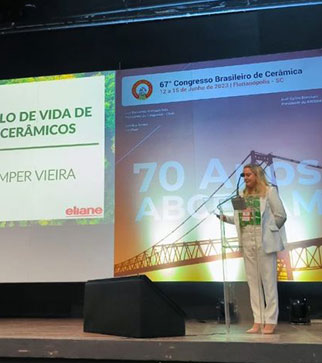
At the 67th Brazilian Congress of Ceramics, held in Florianópolis, Eliane presented what she has been doing in this regard. The R&D coordinator of Eliane, Angela Waterkemper Vieira, from DETEC - Department of Engineering, shared, one of the great cases of the company in the environmental area: Eliane is the first company in Brazil to have a report of LCA - Product Life Cycle Assessment with primary data - data collected within the company itself, encompassing all its 5 production units and all its products, from the extraction of the raw material to the final disposal. "A company that seeks a LCA demonstrates its commitment to the preservation of the environment and sustainability. This approach is crucial, since the knowledge of the environmental impacts of the product allows the company to implement strategies that reduce its environmental footprint, contributing to the preservation of natural resources, the minimization of pollution and the promotion of socio-environmental responsibility.", points out the coordinator. The event, considered the most important event of the segment in Brazil and one of the largest internationally, brings together professionals from teaching and research institutions, ceramic industries from various segments and suppliers of raw materials, equipment and inputs. "The amount of people interested, during our explanation, in addition to the interactions made and the questions asked after the presentation motivated me as a professional, in the certainty that we are on the right track," concludes Angela.
Eliane's Life Cycle Assessment Currently there are some standards that can be followed for the preparation of a LCA, the main ones are DIN EN 15804 and the ISO 14040 series, in this way, these were chosen by Eliane to conduct the studies and applications of the methodology. These standards bring 4 main steps for the realization of the LCA study, which were also followed by the company, these being: Step 1 - Definition of the objective and scope: Step 2 - Inventory Analysis: Step 3 - Impact assessment: Step 4 - Interpretation: The results showed that the greatest impact occurs during the manufacture of the product, that is, from the cradle to the gate, in which the stage that appeared most frequently was the preparation of mass, which includes from the collection of raw materials to the production of atomized powder, which had as its main influence the consumption and transportation of some raw materials and fuels for thermal energy generation. Regarding the stage from the gate to the tomb, which comprises from the factory gate to the final disposal of the product, the greatest impact was caused by the transport of the ceramic tiles to the customer and by the installation of the product, due to the consumption of mortar for settlement.